
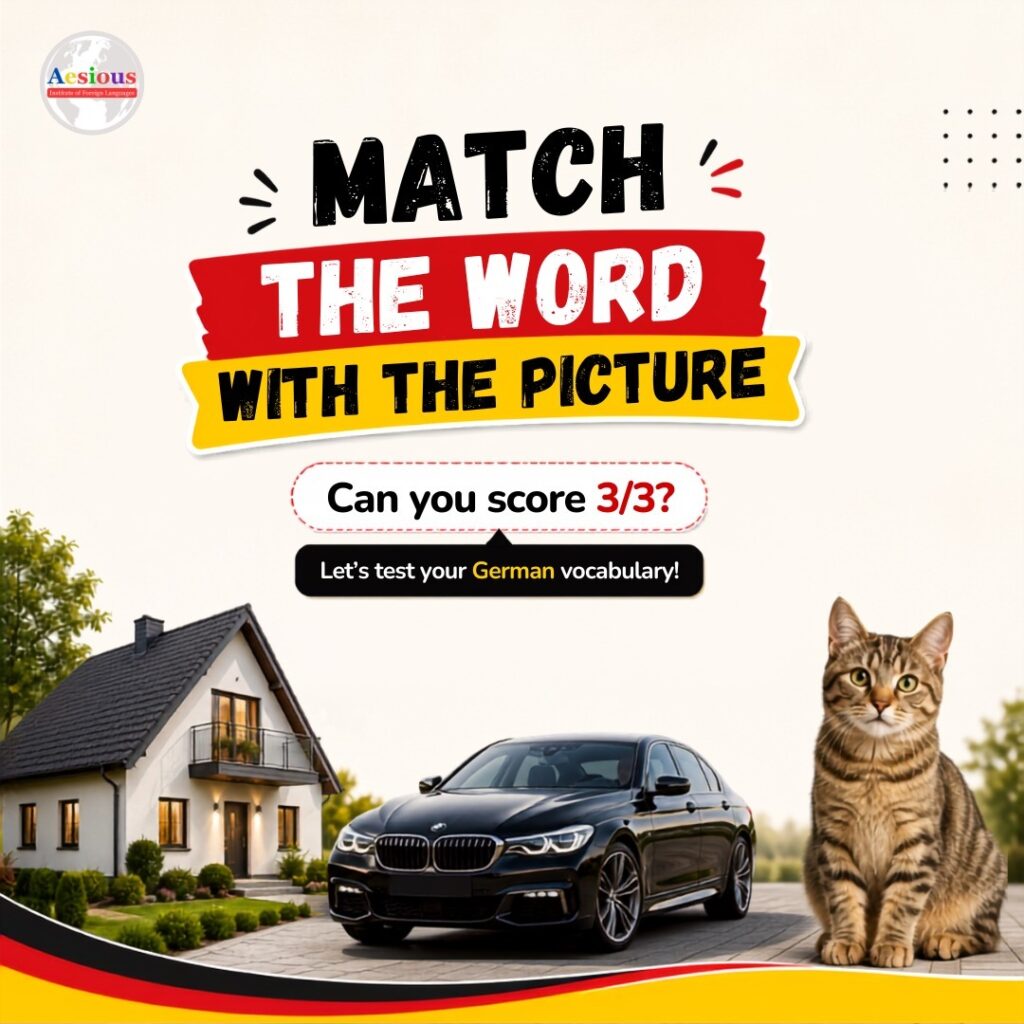
Learning a new language becomes easier when you can connect words with things you already recognize.
Table of Contents
For German beginners, vocabulary is one of the first important steps. Instead of memorizing a long list of unfamiliar words, you can learn through pictures, pronunciation and simple sentences.
In this German vocabulary challenge, look at the three pictures and try to identify their German names.
The pictures represent:
House
Car
Cat
Can you match all three correctly?
Let’s find out.
1. House in German: Haus
The first picture shows a house.
The German word for house is:
Haus
Haus = House
Pronunciation: Howss
You can use this word in a simple German sentence:
Das ist ein Haus.
Meaning: This is a house.
You may also come across:
- das Haus = the house
- ein Haus = a house
- mein Haus = my house
- zu Hause = at home
Easy Way to Remember Haus
The English word house and German word Haus are quite similar.
When you see a house, try to think:
House → Haus
This type of visual association can make beginner German vocabulary easier to revise.
2. Car in German: Auto
The second picture shows a car.
In German, car is:
Auto
Auto = Car
Pronunciation: Ow-toh
Here is a simple example:
Das ist mein Auto.
Meaning: This is my car.
Other useful expressions include:
- das Auto = the car
- ein Auto = a car
- mein Auto = my car
- ein neues Auto = a new car
The word Auto is particularly easy for many beginners because English also uses “auto” in words such as automobile.
So remember:
Car → Auto
3. Cat in German: Katze
The third picture shows a cat.
The German word for cat is:
Katze
Katze = Cat
Pronunciation: approximately KAH-tsuh
For example:
Das ist eine Katze.
Meaning: This is a cat.
Some useful forms are:
- die Katze = the cat
- eine Katze = a cat
- meine Katze = my cat
- kleine Katze = small cat
The spelling and pronunciation of Katze may take a little practice for new learners.
One simple way to remember it is to connect the word directly with the picture of a cat.
German Vocabulary Challenge: Check Your Answers
Now let’s see how many you got right.
| Picture | German Word | English Meaning |
|---|---|---|
| House | Haus | House |
| Car | Auto | Car |
| Cat | Katze | Cat |
How Did You Score?
3/3: Excellent. You already know three useful German words.
2/3: Good start. Revise the third word and try the challenge again.
1/3: No problem. You have three new words to practise.
0/3: Start again. Learning a language is about practice, not getting everything right on the first attempt.
Why Learn German Vocabulary Through Pictures?
Vocabulary is easier to use when you understand it in context.
Instead of simply reading:
Haus = House
you can connect the word with a picture of a house and then use it in a sentence:
Das ist ein Haus.
The same approach works with everyday objects.
For example:
Buch = Book
Stuhl = Chair
Tisch = Table
Tür = Door
Fenster = Window
When you see these objects around you, try recalling their German names.
This turns everyday life into a simple vocabulary practice exercise.
German Vocabulary Is the Foundation for Speaking
Learning individual words is useful, but vocabulary becomes more valuable when you start using it in sentences.
For example:
Das ist ein Haus.
This is a house.
Das ist mein Auto.
This is my car.
Das ist eine Katze.
This is a cat.
As you progress, you can combine more vocabulary and grammar to create longer sentences.
This is why beginners should focus not only on memorizing German words but also on pronunciation, sentence formation, listening and speaking practice.
Aesious describes its teaching approach as interactive, using activities, games, skits and quizzes to make language learning more engaging.
German Vocabulary Start Learning German From A1
If you are completely new to German, A1 is generally the starting level.
A beginner German course can introduce you to:
- German pronunciation
- Basic vocabulary
- Greetings and introductions
- Numbers
- Days and months
- Family vocabulary
- Food and shopping
- Everyday conversations
- Basic grammar
- Sentence formation
- Listening practice
- Speaking practice
After A1, learners can continue towards A2, B1, B2, C1 and C2, depending on their goals and learning requirements.
Aesious currently promotes German learning across A1 to C2 levels.
Who Should Learn German?
German can be useful for different types of learners.
Students
Students planning higher education in Germany or other German-speaking destinations can begin building their language foundation early.
Working Professionals
Professionals interested in international companies and global career opportunities can add German to their existing skill set.
Study Abroad Aspirants
German language skills can be useful for students preparing for education opportunities where German proficiency is required or beneficial.
Beginners
You don’t need previous German knowledge to begin an A1 course.
Language Learners
If you simply enjoy learning languages, German can be an interesting addition to your language skills.
Learn German in Pune With Aesious Institute of Foreign Languages
If you are searching for German classes in Pune or German classes in Aundh, choosing a course that combines vocabulary with practical communication can make the learning process more engaging.
Aesious Institute of Foreign Languages offers language learning programs designed around practical and interactive learning. Its online presence currently highlights German courses, speaking practice and multiple proficiency levels. (Aesious Institute Pune)
The institute is located in the Pune area and its current business listing shows German learners among its students, along with a 4.9 Google rating from 28 reviews at the time of checking. (Aesious Institute)
If you are considering a German course, compare the course level, teaching approach, batch schedule, learning format and your personal goal before enrolling.
A Simple German Vocabulary Practice Method
You can practise German vocabulary at home using this five-step method.
Step 1: Choose Five Objects
Look around your room and select five everyday objects.
Step 2: Find Their German Names
For example:
| English | German |
|---|---|
| Book | Buch |
| Chair | Stuhl |
| Door | Tür |
| Window | Fenster |
| Table | Tisch |
Step 3: Say Each Word Aloud
Pronunciation is important, so don’t only read the words silently.
Step 4: Create Simple Sentences
For example:
Das ist ein Buch.
This is a book.
Step 5: Revise the Words
Come back to the same words the next day and check whether you can remember them without looking.
Consistent practice is more useful than trying to memorize a large vocabulary list in one sitting.
Final German Vocabulary Challenge
You have learned three words from today’s picture challenge:
Haus = House
Auto = Car
Katze = Cat
Now try to create one German sentence using each word.
For example:
Das ist ein Haus.
Das ist mein Auto.
Das ist eine Katze.
Once these sentences become comfortable, add five more everyday German words to your vocabulary.
Small steps like these can help you gradually build the foundation needed for German communication.
Start Your German Learning Journey
Learning German does not have to begin with complicated grammar.
Start with everyday words.
Connect them with pictures.
Say them aloud.
Use them in simple sentences.
Practise them regularly.
And gradually move from vocabulary to real conversations.
If you are looking for a German A1 course in Pune, explore the learning options available at Aesious Institute of Foreign Languages and choose a course that matches your goals, schedule and current level.
Start with one word today. Build your German vocabulary one word at a time.
FAQs
What are some easy German words for beginners?
Some beginner-friendly German words include Haus (house), Auto (car), Katze (cat), Buch (book), Wasser (water) and Hallo (hello).
How can I improve my German vocabulary?
Practise everyday vocabulary using pictures, flashcards, short sentences, listening exercises and regular speaking practice.
Is German A1 suitable for complete beginners?
Yes. A1 is the beginner level and is suitable for learners who have little or no previous German knowledge.
Where can I learn German in Pune?
You can explore German language institutes in Pune and compare their course levels, teaching methods, schedules and learning formats. Aesious Institute of Foreign Languages offers German learning programs and promotes A1 to C2 levels.
Can picture-based activities help with German vocabulary?
Yes. Connecting a German word with an image can create a simple visual association and make vocabulary revision more engaging.

