
Discover 7 funny German words and their surprising meanings through real-life situations. Learn German vocabulary in a fun and memorable way. Learning German for the first time can feel like entering a completely new world. The pronunciation is different, the sentence structure takes some getting used to, and then there are those German words that make you stop and think, “Wait, this is actually a word?”
That is one of the fun parts of learning a foreign language.
Table of Contents
When vocabulary is connected with something funny, surprising, or relatable, it often becomes much easier to remember. Instead of memorising another long vocabulary list, you start associating a word with a situation, a feeling, or even a funny mental picture.
At Aesious Institute of Foreign Languages in Pune, language learning is not only about remembering grammar rules. Exploring interesting expressions and using language in relatable situations can make the learning process more engaging.
So, let’s look at seven German words that are particularly memorable for learners.
German Can Be Surprisingly Creative
One thing many beginners notice about German is its ability to combine words.
Sometimes, two familiar ideas come together and create a word with a meaning that feels completely unexpected when you first see it.
For a learner, these words can actually be useful.
Why?
Because instead of remembering an abstract vocabulary item, you have a story behind the word.
Here are seven examples that can make your German vocabulary practice a little more interesting.

1. Kummerspeck: When Your Emotions Affect Your Eating
Imagine having a difficult week.
You are stressed, your favourite series is on, and suddenly you find yourself reaching for snacks again and again.
German has a wonderfully memorable expression for the extra weight associated with emotional eating: Kummerspeck.
The word is built around the ideas of emotional distress and “bacon.”
You probably will not forget it once you understand the idea behind it.
Try remembering it like this:
Kummer = emotional distress
Speck = bacon/fat
The combination gives you a memorable way to connect the word with its meaning.
This is a good example of why understanding how German words are formed can help vocabulary stay in your memory.
2. Ohrwurm: That Song You Cannot Stop Thinking About
You listen to a catchy song in the morning.
By afternoon, you are working, studying, or travelling, but the same tune is still playing inside your head.
You have probably experienced this many times.
German calls this an Ohrwurm.
The word is literally connected with the idea of something being in your ear, which makes the expression surprisingly easy to remember once you know it.
For German learners, this is a perfect everyday vocabulary word because music, conversations and social media constantly give us opportunities to experience it.
Next time a song refuses to leave your head, you will know what German speakers call that experience.
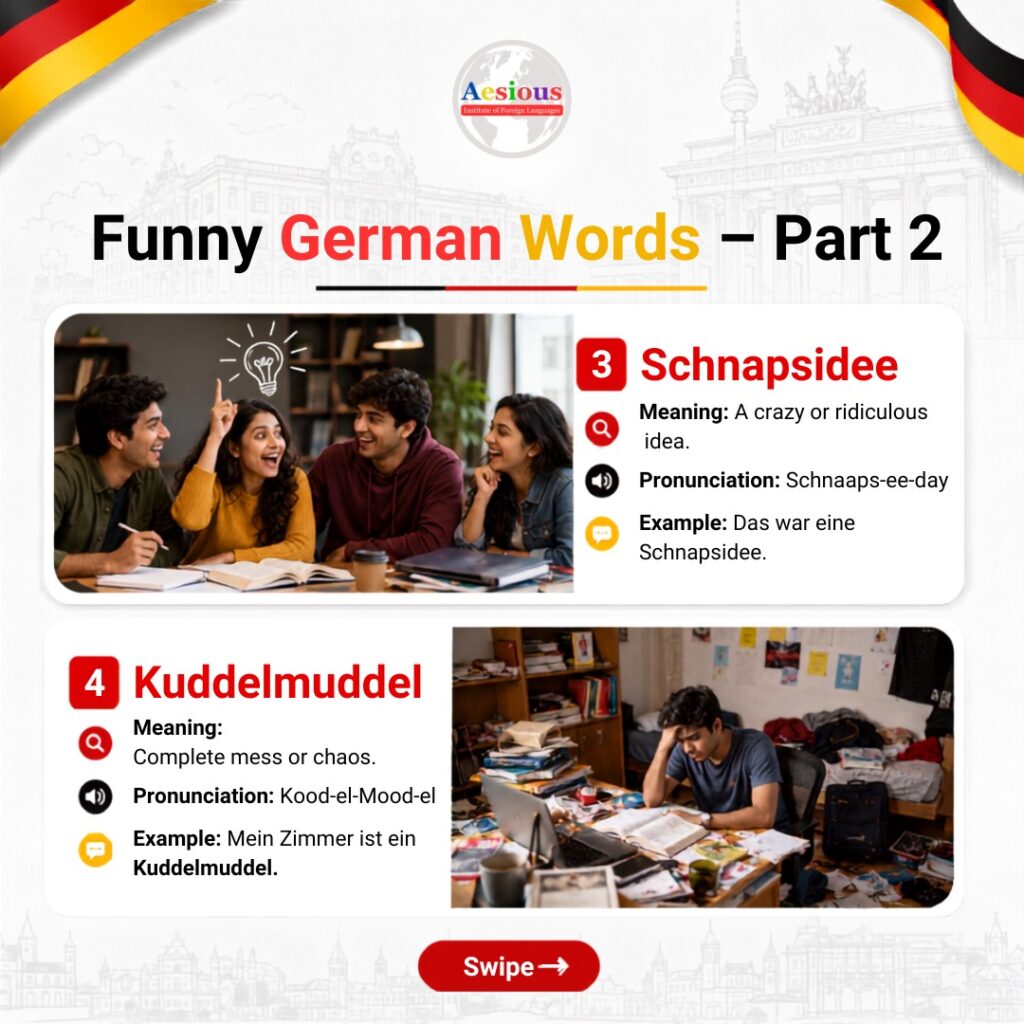
3. Schnapsidee: When a Brilliant Idea Suddenly Becomes a Terrible One
Have you ever had a late-night idea that sounded absolutely brilliant?
Then you thought about it the next morning and wondered why you ever considered it?
That is the kind of situation where the German word Schnapsidee can be useful.
It is used for a foolish, crazy, or unrealistic idea.
The interesting thing about this word is its humorous feeling. It is not simply describing an idea as “bad.” It gives the impression that the idea was so questionable that it might have been created under the influence of alcohol.
A simple situation:
Your friends suddenly decide they want to drive hundreds of kilometres at midnight just because they are bored.
Someone might jokingly call the plan a Schnapsidee.
That makes the vocabulary much easier to remember than simply memorising a dictionary definition.
4. Kuddelmuddel: When Everything Is Mixed Up
Open your study table.
There are notebooks everywhere.
Your charger is under a book, your headphones are missing, and yesterday’s notes are mixed with today’s notes.
That situation can be described using Kuddelmuddel.
It refers to a state of confusion, disorder, or a complete mess.
What makes this word fun is its sound. Even before knowing its meaning, the word itself feels a little chaotic.
That is something language learners can use to their advantage.
When a word sounds memorable and is connected to a strong visual situation, it becomes easier to recall later.


5. Tohuwabohu: When There Is Complete Chaos
Now imagine something much bigger than a messy desk.
A busy event is happening. Everyone is talking at the same time, people are moving around, plans are changing, and nobody seems to know what is happening.
German has Tohuwabohu for a situation of complete chaos or confusion.
It is an expressive word, and that makes it interesting for learners who want to move beyond basic textbook vocabulary.
Learning words like this also introduces you to the personality of a language.
You are not simply learning how to say “chaos.”
You are learning how German speakers can express an entire situation with one memorable word.
6. Fernweh: When You Just Want to Go Somewhere Far Away
This one may feel familiar to anyone who loves travelling.
You are sitting at home, scrolling through photographs from another country. You start imagining yourself walking through a new city, trying different food, hearing another language, and exploring unfamiliar places.
That strong longing to travel or be somewhere far away is expressed by the German word Fernweh.
It is particularly interesting because German also has Heimweh, which refers to homesickness.
So, while one describes a longing for home, the other expresses a longing for somewhere far away.
For students learning German for travel, education, or international opportunities, words like Fernweh can make vocabulary feel connected to real life rather than just a classroom exercise.
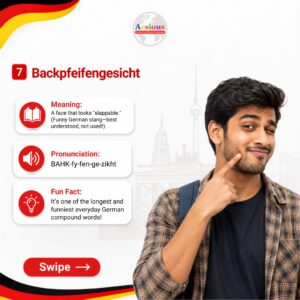
7. Backpfeifengesicht: A Very Unusual Expression
Some German words are memorable because of their meaning.
Others are memorable simply because they are so unusual.
Backpfeifengesicht is one of them.
It is a humorous and rather insulting expression used to describe someone’s face as supposedly deserving a slap.
It is not the kind of word you would normally use casually with someone, especially in a polite conversation.
But from a language-learning perspective, it demonstrates something important:
Knowing a language also means understanding its tone and cultural context.
Not every word you learn should automatically be used in conversation. Some expressions need to be understood first, including when they are appropriate and when they are better left alone.
What These Words Teach Us About Learning German
These seven words are fun, but there is a bigger lesson behind them.
Learning vocabulary does not have to mean writing the same word twenty times in a notebook.
Try connecting new vocabulary with:
- A funny situation
- A personal experience
- A visual image
- A short conversation
- A story
- The way the word is constructed
For example, remembering Fernweh through your dream of travelling can be much easier than trying to memorise it as an isolated vocabulary item.
Similarly, thinking about your messy study table whenever you hear Kuddelmuddel gives the word a personal connection.
Why Learning Through Real Situations Can Help
Language is ultimately meant to be used.
You may know hundreds of German words from a textbook, but the real challenge is remembering them when you actually need to communicate.
That is why practical exposure matters.
Instead of asking only:
“What does this word mean?”
try asking:
“When would a German speaker actually use this word?”
That small change in thinking can make vocabulary learning more practical.
Learning German in Pune
If you are starting German from scratch or want to improve your existing skills, having structured guidance can make the process easier.
Aesious Institute of Foreign Languages | Pune focuses on making language learning engaging through interactive activities, communication-focused learning and practical exposure. The institute offers German learning opportunities for students and learners with different goals.
Whether your motivation is higher education, career development, travel, or simply learning a new language, German becomes more enjoyable when you understand how the language works instead of only memorising vocabulary.
Final Thought
German may look difficult when you first encounter long words and unfamiliar pronunciation.
But once you start discovering expressions such as Kummerspeck, Ohrwurm, Schnapsidee, Kuddelmuddel, Tohuwabohu, Fernweh, and Backpfeifengesicht, you begin to see another side of the language.
It can be funny.
It can be expressive.
And sometimes, it can be surprisingly relatable.
So, instead of worrying about every difficult German word you encounter, try being curious about it.
You might just discover your next favourite German word.
Which of these seven words would you actually use in your daily life?
Frequently Asked Questions
What are some funny German words?
Some memorable German words include Kummerspeck, Ohrwurm, Schnapsidee, Kuddelmuddel, Tohuwabohu, Fernweh, and Backpfeifengesicht.
Why do German words sometimes sound funny?
German uses compound words extensively, meaning smaller words can be combined to create a more specific expression. This can make some words sound unusual to beginners.
What does Ohrwurm mean?
Ohrwurm refers to a song or melody that keeps playing in your mind after you have heard it.
What does Fernweh mean?
Fernweh describes a strong longing to travel or be somewhere far away.
Is Backpfeifengesicht a polite German word?
No. It is a humorous but insulting expression, so learners should understand its context rather than casually use it with people.
Where can I learn German in Pune?
Learners looking for German language training in Pune can explore Aesious Institute of Foreign Languages and choose a learning path based on their current level and goals.