
German Quiz Learn the German word Haus for house and discover 7 easy ways to build German vocabulary, sentences and speaking confidence with Aesious in Aundh, Pune.
Learning German can be much easier when you connect new words with things you see every day.
Table of Contents
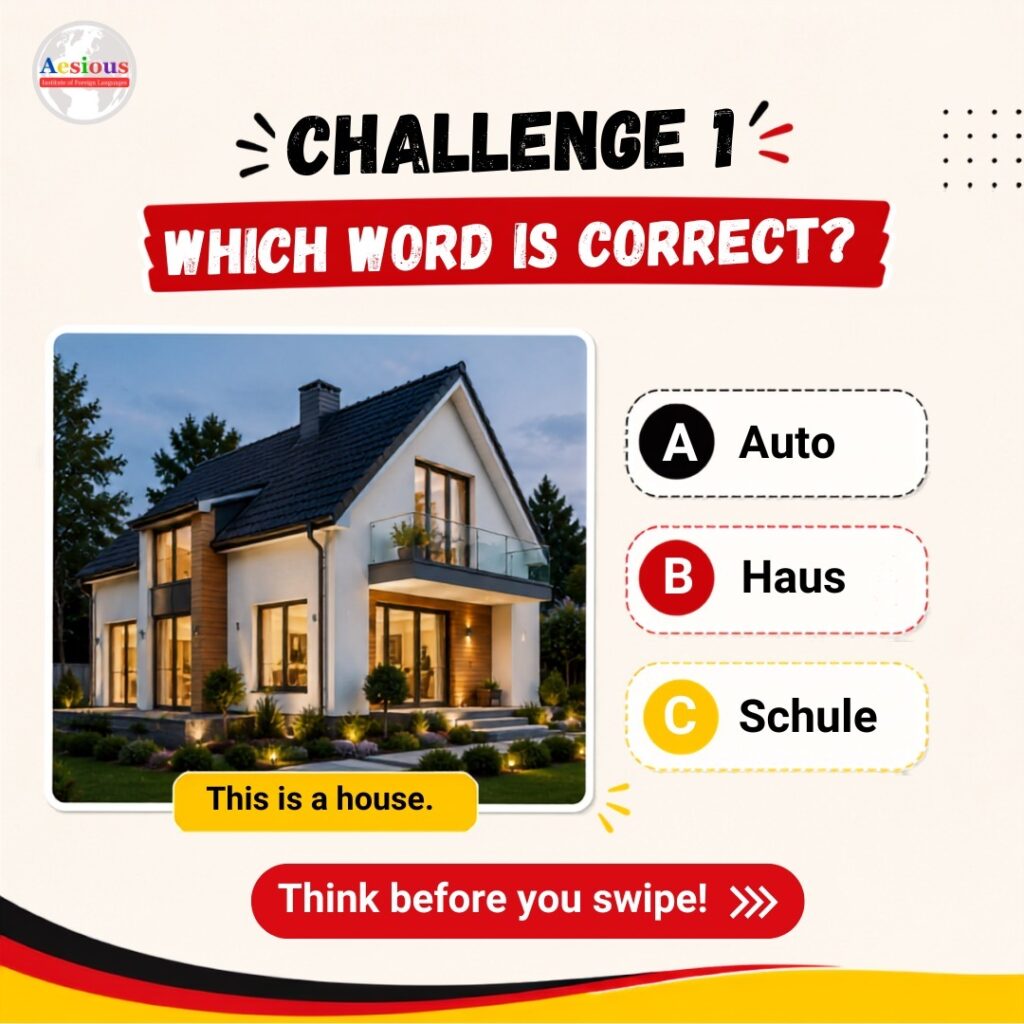
Take a look at the house in the image above.
Which German word means “House”?
A. Auto
B. Haus
C. Schule
✅ Correct Answer: B. Haus
Haus = House 🏠
If you chose Haus, Sehr gut! 🇩🇪
If you didn’t, that’s completely fine. You have just learned an important German word that beginners can use in everyday sentences.
This simple challenge is a great example of how visual vocabulary learning can make a new language more memorable.
For learners looking for German language classes in Aundh Pune, building a strong everyday vocabulary is an important first step toward speaking and understanding German.
🇩🇪 What Does “Haus” Mean in German Quiz?
Haus is the German word for house.
German
Haus
English
House
German Quiz Example sentence
Das ist ein Haus.
English: This is a house.
You can also expand the sentence:
Das ist ein großes Haus.
English: This is a big house.
And another example:
Mein Haus ist schön.
English: My house is beautiful.
Learning a word in several sentences helps you understand how it works in real communication instead of memorising only a translation.
Auto, Haus or Schule? Know the Difference German Quiz
The challenge gives you three German words.
| German Word | English Meaning |
|---|---|
| Auto | Car |
| Haus | House |
| Schule | School |
Auto
Auto = Car
Example:
Das ist ein Auto.
This is a car.
Haus
Haus = House
Example:
Das ist ein Haus.
This is a house.
Schule
Schule = School
Example:
Die Schule ist groß.
The school is big.
These three words are useful examples of how beginners can build vocabulary around familiar objects and places.
Why Should Beginners Learn German Vocabulary in German Quiz?
Vocabulary is one of the foundations of language learning.
The more useful words you understand, the easier it becomes to:
- Build simple sentences
- Understand everyday conversations
- Ask basic questions
- Describe people and objects
- Talk about your daily life
- Improve listening comprehension
- Develop speaking confidence
- Read simple German texts
However, vocabulary should not be learned in isolation.
A strong German-learning routine should combine vocabulary, grammar, pronunciation, listening and speaking practice.
7 Easy Ways to Improve Your German Vocabulary German Quiz
1. Connect German Words With Pictures
Visual association is a simple way to practise vocabulary.
Look at a picture of a house and think:
Haus 🏠
Look at a car:
Auto 🚗
Look at a school:
Schule 🏫
This turns ordinary objects into opportunities for German practice.
2. Learn Everyday German Words First
Beginners don’t need to start with complicated vocabulary.
Start with words you are likely to use frequently.
Home
- Haus = House
- Tür = Door
- Fenster = Window
- Zimmer = Room
- Küche = Kitchen
Transport
- Auto = Car
- Bus = Bus
- Zug = Train
- Fahrrad = Bicycle
Education
- Schule = School
- Buch = Book
- Lehrer = Teacher
- Student = Student
This gives you vocabulary that can be immediately used in simple conversations.
3. Learn German Words Inside Sentences German Quiz
Instead of memorising:
Haus = House
try:
Das ist ein Haus.
Then:
Das Haus ist groß.
Then:
Mein Haus ist groß.
You are gradually learning:
Vocabulary → Sentence → Meaning → Communication
This is much more useful than simply memorising a translation.
4. Create Your Own German Vocabulary Challenges
Turn revision into a quiz.
What is “House” in German?
A. Auto
B. Haus
C. Schule
Answer: Haus ✅
You can create five questions every day.
After learning 20 new words, test yourself without looking at the answers.
5. Practise German Speaking
Knowing a German word is only the beginning.
Try saying it aloud.
For example:
Haus
Then:
Das ist ein Haus.
Then ask:
Was ist das?
Answer:
Das ist ein Haus.
This simple question-and-answer technique helps you move from vocabulary recognition toward practical speaking.
6. Use German Around You
You don’t always need a textbook to practise.
Look around your room.
Can you identify anything in German?
For example:
🏠 House → Haus
🚪 Door → Tür
🪟 Window → Fenster
📖 Book → Buch
🪑 Chair → Stuhl
Try naming five objects every day.
This can turn your daily environment into a mini German classroom.
7. Revise Consistently
Learning 50 words in one day and forgetting them a week later isn’t very useful.
Instead, use regular revision.
Simple 30-minute routine
10 minutes: Learn new vocabulary
10 minutes: Create sentences
5 minutes: Speak aloud
5 minutes: Revise yesterday’s words
Consistency can help you gradually develop a stronger vocabulary.
🇩🇪 German A1 Vocabulary for Beginners
If you are starting German from zero, A1 is generally the beginner level.
You can begin with topics such as:
Greetings
- Hallo = Hello
- Guten Morgen = Good morning
- Guten Abend = Good evening
- Danke = Thank you
- Bitte = Please / You’re welcome
People
- Mann = Man
- Frau = Woman
- Kind = Child
- Freund = Friend
Places
- Haus = House
- Schule = School
- Stadt = City
- Bahnhof = Train station
Everyday Objects
- Buch = Book
- Tisch = Table
- Stuhl = Chair
- Tasche = Bag
- Handy = Mobile phone
As you progress German Quiz , you can move from basic vocabulary to more complex grammar, listening and conversational skills.
Learn German Through Practical Examples
Imagine you’re visiting a German-speaking country.
You see a beautiful house.
Instead of thinking only in English:
“That’s a house.”
Try thinking:
Das ist ein Haus.
You see a car:
Das ist ein Auto.
You see a school:
Das ist eine Schule.
Now you aren’t simply memorising German words.
You’re using German to describe the world around you.
That is an important transition for beginners.
Looking for German Language Classes in Aundh Pune?
If you are searching for German language classes in Aundh Pune, consider more than just the number of vocabulary words included in a course.
Look for a learning program that supports:
- Vocabulary development
- Grammar
- Pronunciation
- Listening
- Speaking
- Sentence formation
- Conversation practice
- Regular revision
- Practical language use
Aesious Institute of Foreign Languages in Aundh, Pune focuses on foreign-language education and promotes interactive learning through activities such as quizzes, games and practical communication in its published materials.
For a beginner, this type of learning can make vocabulary practice more engaging than relying only on memorisation.
Who Can Learn German?
German can be learned by different types of students and learners.
Students
Students may choose German as an additional skill or for academic and future international opportunities.
Working Professionals
Professionals can develop German communication skills for international work environments and personal career goals.
Travellers
Basic German vocabulary can help with everyday communication while travelling.
Language Enthusiasts
You can also learn German simply because you enjoy discovering new languages and cultures.
Your learning plan should depend on your personal objective.
German Vocabulary Challenge
Let’s test what you’ve learned.
1. What is “House” in German?
A. Auto
B. Haus
C. Schule
Answer: Haus ✅
2. What is “Car” in German?
A. Auto
B. Haus
C. Buch
Answer: Auto ✅
3. What is “School” in German?
A. Schule
B. Katze
C. Haus
Answer: Schule ✅
4. What is “Book” in German?
A. Buch
B. Auto
C. Hund
Answer: Buch ✅
5. What is “Cat” in German?
A. Vogel
B. Katze
C. Schule
Answer: Katze ✅
Your Score
5/5: 🇩🇪 Sehr gut!
3–4/5: 👏 Gut gemacht!
1–2/5: 👍 Keep practising!
Conclusion
Learning German doesn’t have to begin with a complicated German grammar Quiz.
Start with one familiar word:
🏠 Haus = House
Then turn that word into a sentence:
Das ist ein Haus.
Then add another word.
Then another sentence.
Then start a conversation.
This gradual approach can help beginners develop vocabulary and become more comfortable using German in everyday situations.
If you’re searching for German language classes in Aundh Pune, choose a course that combines vocabulary with speaking, listening, grammar, pronunciation and practical communication.
Aesious Institute of Foreign Languages, Aundh, Pune provides a local option for learners interested in foreign-language education and interactive German learning.
🇩🇪 Ready for the next challenge?
Learn one German word today. Use it in a sentence tomorrow. Build your confidence step by step.
Frequently Asked Questions
What does Haus mean in German?
Haus means house in English.
Example:
Das ist ein Haus.
This is a house.
What is the German word for house?
The German word for house is Haus.
What is Auto in German?
Auto means car.
Example:
Das ist ein Auto.
This is a car.
What does Schule mean?
Schule means school in English.
Example:
Die Schule ist groß.
The school is big.
How can beginners improve their German vocabulary?
Start with common everyday words, learn vocabulary by topic, use new words in sentences, practise speaking aloud and revise regularly.
What German level should a beginner start with?
A complete beginner will generally start with A1. Learners who already have German knowledge can determine their appropriate level through an assessment.
Are German vocabulary quizzes useful?
Yes. Quizzes encourage active recall, which can make vocabulary revision more engaging and help learners identify words they need to practise again.
Where can I learn German in Aundh Pune?
If you’re looking for German classes in Aundh, compare institutes based on course levels, teaching methods, speaking practice, trainer support, timings and your learning objectives.

