
Test your German vocabulary with this fun cat challenge and learn 7 simple ways to improve German speaking, vocabulary and confidence in Aundh, Pune.
German Language Classes in Aundh Pune: 7 Fun Ways to Master German
Learning German doesn’t have to start with complicated grammar rules or long vocabulary lists.
Sometimes, one simple picture can make a new German word much easier to remember.
Table of Contents
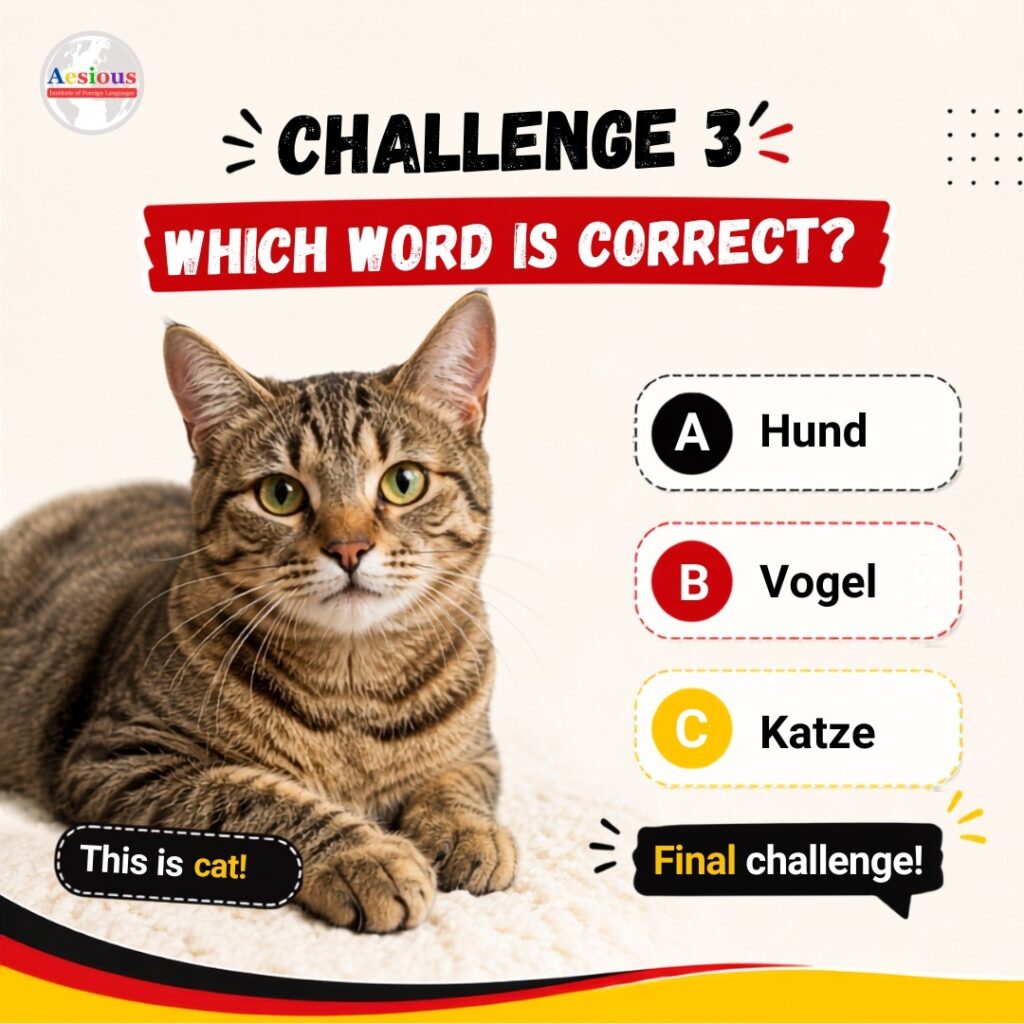
Look at the challenge above.
Which German word means “Cat”?
A. Hund
B. Vogel
C. Katze
The correct answer is:
C. Katze
Katze = Cat
Congratulations if you chose C!
If you selected Hund, don’t worry. Hund means dog, while Vogel means bird.
This type of visual vocabulary challenge is a simple way to make German learning more engaging, especially for beginners.
At Aesious Institute of Foreign Languages, Aundh, Pune, the learning approach emphasizes interactive activities such as games, quizzes, skits and practical language use rather than relying only on traditional teaching.
🇩🇪 What Does “Katze” Mean in German?
The German word Katze means cat.
English:
Cat
German:
Katze
Example sentence:
Die Katze ist klein.
English: The cat is small.
Learning a word becomes much more useful when you learn how to use it in a sentence.
Instead of memorising:
Katze = Cat
try remembering:
Die Katze ist klein.
This gives you vocabulary, sentence structure and practical usage at the same time.
Don’t Confuse Katze, Hund and Vogel
The challenge includes three useful German animal words.
| German Word | English Meaning |
|---|---|
| Katze | Cat |
| Hund | Dog |
| Vogel | Bird |
These are simple words, but they are excellent for beginner vocabulary practice.
Example 1
Die Katze ist klein.
The cat is small.
Example 2
Der Hund ist groß.
The dog is big.
Example 3
Der Vogel fliegt.
The bird flies.
Notice that learning vocabulary through complete sentences gives you more context than simply memorising translations.
Why Is German Language Classes German Vocabulary Important for Beginners?
Vocabulary is one of the foundations of language learning.
You need words to:
- Introduce yourself
- Ask questions
- Understand conversations
- Describe people and objects
- Talk about your daily routine
- Express opinions
- Understand written German
- Build sentences
- Improve speaking confidence
However, vocabulary alone isn’t enough.
A learner also needs pronunciation, grammar, listening and speaking practice.
That is why effective German learning should gradually move from individual words to phrases, sentences and real conversations.
Aesious describes its German learning approach as practical and communication-focused, with German courses covering levels from A1 to C2 according to its published information. (Aesious Institute Pune)
7 Fun Ways to Learn German Vocabulary Faster
1. Learn German With Pictures
Pictures can create a direct association between an object and its German word.
For example:
🐱 Katze
🐶 Hund
🐦 Vogel
🏠 Haus
🚗 Auto
Instead of translating every word mentally, try connecting the German word directly with the object.
2. Turn Vocabulary Into a Quiz
Quizzes make learning more active.
For example:
Which word means “dog”?
A. Katze
B. Hund
C. Vogel
Answer: B. Hund ✅
You can create small vocabulary challenges every day.
Try five words today.
Tomorrow, test yourself again without looking at the answers.
3. Learn Words in Groups
Don’t always learn random vocabulary.
Create categories.
- Katze = Cat
- Hund = Dog
- Vogel = Bird
- Pferd = Horse
- Fisch = Fish
Animals
Home
- Haus = House
- Tür = Door
- Fenster = Window
- Zimmer = Room
- Küche = Kitchen
Everyday Objects
- Buch = Book
- Tisch = Table
- Stuhl = Chair
- Tasche = Bag
- Handy = Mobile phone
Grouped vocabulary is easier to practise because the words have a common context.
4. Use German Words in Sentences
One of the best ways to move from vocabulary recognition to actual communication is to use new words in sentences.
Instead of:
Katze = Cat
try:
Das ist eine Katze.
Meaning:
This is a cat.
Then make another sentence:
Meine Katze ist klein.
Meaning:
My cat is small.
This gradually builds your ability to form German sentences.
5. Practise German Speaking Every Day
Knowing a word and being able to say it confidently are two different things.
Try speaking simple sentences every day.
For example:
Hallo!
Hello!
Ich heiße Vaishnavi.
My name is Vaishnavi.
Ich lerne Deutsch.
I am learning German.
Das ist eine Katze.
This is a cat.
Even simple sentences can help beginners become comfortable with speaking.
6. Learn Pronunciation Along With Vocabulary
Don’t only learn how a German word is written.
Learn how it sounds.
For example:
Katze
is approximately pronounced:
KAT-tsuh
The exact pronunciation should be learned through listening and instructor feedback rather than relying entirely on English spelling.
Listening and repeating the word can help you develop better pronunciation habits.
7. Make German Part of Your Daily Routine
You don’t need to spend hours every day memorising vocabulary.
Start small.
A simple daily routine:
10 minutes: New vocabulary
10 minutes: Listening
10 minutes: Speaking
5 minutes: Revision
Consistency matters more than trying to learn hundreds of words in one sitting.
🎯 German Vocabulary Challenge: Can You Score 5/5?
Let’s test your knowledge.
Question 1: What is “Cat” in German?
A. Hund
B. Katze
C. Vogel
Answer: Katze ✅
Question 2: What is “Dog” in German?
A. Hund
B. Katze
C. Haus
Answer: Hund ✅
Question 3: What is “Bird” in German?
A. Auto
B. Vogel
C. Buch
Answer: Vogel ✅
Question 4: What is “House” in German?
A. Haus
B. Hund
C. Katze
Answer: Haus ✅
Question 5: What is “Car” in German?
A. Buch
B. Auto
C. Vogel
Answer: Auto ✅
Your Score
5/5: 🇩🇪 Sehr gut!
3–4/5: 👍 Gut gemacht!
1–2/5: Keep practising. You’re getting started!
German Learning for Beginners in Aundh, Pune
If you’re searching online for German Language Classes in Aundh Pune, don’t choose a course only because it promises quick vocabulary memorisation.
Look for a learning environment where you can gradually develop:
- German vocabulary
- Grammar
- Pronunciation
- Listening skills
- Speaking skills
- Sentence formation
- Conversational confidence
- Regular practice
Aesious Institute of Foreign Languages in Aundh presents its teaching approach around interactive language learning and practical communication. Its published German content also highlights real-life speaking practice and courses from A1 to C2.
This is particularly relevant for learners who don’t want to restrict their German learning to textbook exercises.
Who Can Learn German?
German can be useful for different types of learners.
Students
Students interested in Germany, German-speaking countries or international education may choose German as an additional language skill.
Working Professionals
Professionals may learn German to improve communication skills or prepare for opportunities involving German-speaking clients, teams or markets.
Future Travellers
Learning basic German can make everyday communication during travel more comfortable.
Language Enthusiasts
You don’t need a career-related reason to learn a language. Some people simply enjoy discovering new languages and cultures.
The important thing is to choose a learning goal and practise consistently.
German A1: Where Beginners Can Start
For someone starting German from zero, A1 is generally the beginner level.
At the beginning, learners commonly work on areas such as:
- Greetings
- Introducing yourself
- Numbers
- Family
- Food
- Colours
- Daily activities
- Basic questions
- Common vocabulary
- Simple sentence structures
- Basic grammar
- Everyday conversations
From there, learners can progress to higher proficiency levels according to their goals and course requirements.
Aesious publicly describes German learning from A1 through C2, giving learners a structured progression path.
Why Interactive Learning Can Make German More Interesting
Imagine two different lessons.
Traditional vocabulary practice
Katze = Cat
Hund = Dog
Vogel = Bird
Read. Memorise. Repeat.
Interactive practice
Teacher: Was ist das?
Student: Das ist eine Katze.
Teacher: Ist die Katze groß?
Student: Nein, die Katze ist klein.
Now the learner is using vocabulary in a conversation.
This type of practice can make vocabulary more memorable because students are actively recalling and applying the words.
Aesious positions its language-learning experience around activities such as games, quizzes, skits and interactive practice, which fits naturally with the visual challenge shown in this article.
Looking for German Classes in Aundh Pune?
If you live around Aundh, Baner or the Pune University area and want to learn German, consider comparing local institutes based on:
✔ Course levels
Does the institute offer the level you need?
✔ Speaking practice
Will you actually get opportunities to speak German?
✔ Interactive teaching
Are lessons limited to textbooks, or do they include activities and practical exercises?
✔ Trainer support
Can you ask questions and receive feedback?
✔ Learning goals
Does the course fit your reason for learning German?
✔ Schedule
Does the batch timing work with your college, job or other commitments?
These factors can help you choose a course based on your actual needs rather than simply choosing the first result you see in Google.
Conclusion
Learning German can start with something as simple as a picture of a cat.
Katze = Cat. 🐱
But the real goal isn’t simply to memorise one German word. The goal is to gradually turn vocabulary into sentences, conversations and confident communication.
Start with everyday words.
Practise pronunciation.
Build simple sentences.
Test yourself with quizzes.
Speak regularly.
Then gradually progress from beginner-level German toward higher proficiency.
For learners searching for German language classes in Aundh Pune, Aesious Institute of Foreign Languages offers an interactive approach that incorporates activities, quizzes, games and practical language learning. Its published German materials describe learning opportunities from A1 to C2 and emphasize real-life communication.
So, how did you do in today’s challenge?
🐱 Katze
🐶 Hund
🐦 Vogel
Comment your score: 1/5, 3/5 or 5/5! 🇩🇪
Frequently Asked Questions
1. What is Katze in German?
Katze means cat in English.
Example:
Die Katze ist klein.
The cat is small.
2. What is Hund in German?
Hund means dog in English.
Example:
Der Hund ist groß.
The dog is big.
3. What is Vogel in German?
Vogel means bird in English.
Example:
Der Vogel fliegt.
The bird flies.
4. How can beginners learn German vocabulary?
Start with common everyday words, practise them in sentences, listen to their pronunciation and revise them regularly. Quizzes and visual learning can also make vocabulary practice more engaging.
5. Where can I learn German in Aundh Pune?
If you’re looking for German language classes in Aundh Pune, compare institutes based on teaching methodology, speaking practice, course levels, trainer support, timings and your personal learning objective.
6. What German level should a complete beginner start with?
A complete beginner will generally start at A1, while learners with previous German knowledge may need an assessment to determine the appropriate level.
7. Can I learn German mainly for speaking?
Yes. If speaking is your priority, look for a course that provides regular conversational practice rather than focusing only on written grammar and vocabulary.
8. Is learning German useful for students and professionals?
It can be useful depending on your academic or professional goals. German may support communication, education, travel and international career objectives, but specific university or employment requirements should always be checked separately.

